

In a child’s developmental journey, there are pivotal milestones that shape their future path, and among the most prominent
and important is the kindergarten stage. Often, this stage is viewed merely as a place for play and passing time before “real school,” but reality tells us a completely different story.
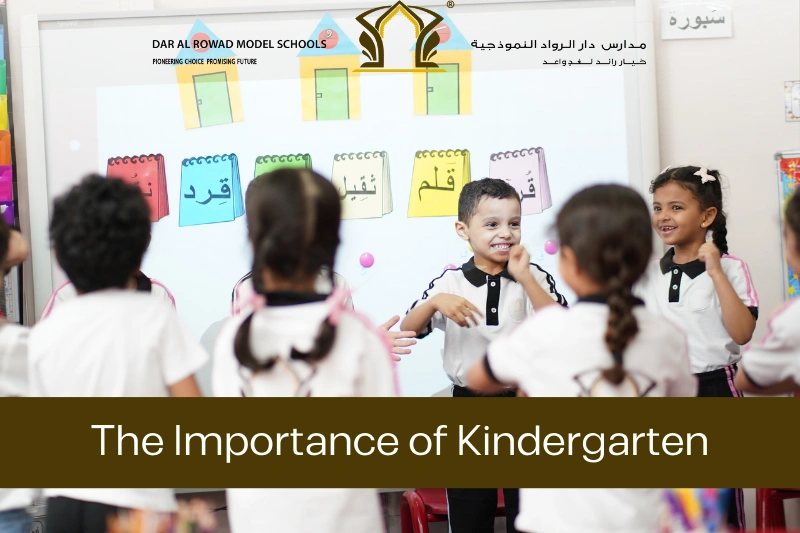
The importance of kindergarten in building a child’s personality stems from it being the first organized experience where a child explores the world beyond their immediate family circle. Here, children don’t just learn letters and numbers; they learn how to become individuals capable of communication, cooperation, self-control, and expressing their feelings.
At Dar Al-Ruwad School, we believe that investing in this sensitive stage is an investment in the entire future. We work to provide a rich and stimulating environment that unleashes each child’s potential and lays the foundation for a strong, balanced personality ready for lifelong learning.
How Kindergarten Shapes a Child’s Future
The importance of kindergarten in building a child’s personality is not limited to one aspect; rather, it is a comprehensive and integrated process that touches every facet of development. To understand this profound impact, we can examine the key areas that develop during this critical stage:
Social and Emotional Development (The Foundation): Kindergarten is a child’s first miniature society, where they acquire fundamental social skills that will determine their relationship patterns in the future, such as sharing, respecting turns, and teamwork cooperation.
A Safe Environment for Emotional Expression: Children learn to express their feelings—from joy and enthusiasm to anxiety or anger—in constructive ways, which enhances their emotional intelligence and ability to empathize with others. These daily experiences build their self-confidence and make them feel secure when interacting with the world around them.
Cognitive and Creative Development (Unleashing Thinking): Moving away from traditional rote learning methods, kindergarten offers education through play and exploration. Through diverse activities such as drawing, crafts, stories, and building games, a child’s imagination and creativity are stimulated.
Learning New Skills and Concepts: Children naturally learn simple mathematical and scientific concepts, and develop problem-solving and critical thinking skills when asked, for example, to build a tower from blocks or solve a simple puzzle. These processes activate their minds and prepare them to acquire academic knowledge more deeply in later stages.
Behavioral and Values Development (Establishing the Internal Compass): In kindergarten, children begin to absorb the values and morals that shape their personality. They learn the meaning of respect through interactions with their teachers and peers, and learn honesty and integrity in their simple interactions. Following a clear daily routine and participating in setting simple classroom rules help them develop self-discipline and responsibility.
The Role of the Teacher in a Child’s Life
If kindergarten is the building, then the teacher is the engineer who plans, supervises, and guides. Her role goes beyond transmitting information to being a form of comprehensive education. Studies and educational experiences indicate that the teacher’s qualities and skills are the biggest factor in achieving the importance of kindergarten in building a child’s personality positively. Among the most prominent of these qualities:
Good Role Model and Emotional Intelligence: At this age, children learn through observation and imitation more than instruction. A teacher who demonstrates calmness, patience, and kindness in her interactions, and possesses emotional intelligence that enables her to understand and reflect children’s feelings, becomes a role model that children emulate in their behavior.
Creativity and Ability to Motivate: A creative teacher captures children’s attention and transforms learning into an adventure. Whether through designing interactive activities that combine learning and play, or using stories and songs to reinforce concepts, her creativity is what instills the love of exploration and learning in young hearts.
Communication Skills and Collaboration with Families: The importance of kindergarten in building a child’s personality is enhanced when there is a strong bridge of trust and cooperation between the teacher and parents. A successful teacher is one who places parents at the heart of the educational process, through regular communication to inform them about the child’s development, strengths, and areas needing support, creating consistency between home and school environments for the child’s benefit.
At Dar Al-Ruwad School, we recognize this pivotal role, and therefore we carefully select kindergarten teachers, not only based on their academic qualifications, but also on their passion for teaching, receptiveness to continuous training, and possession of personal qualities that make them true partners with parents in the nurturing journey.
How Can Parents Maximize Their Child’s Benefit from Kindergarten?
Integrated education is the key to success. Kindergarten and family are partners in building a child’s personality, not substitutes for each other. Parents can follow practical strategies to strengthen this partnership and achieve maximum benefit from the kindergarten stage:
Positive Preparation and Open Communication: Talk to your child about kindergarten in a positive manner, describing it as a place to play and meet new friends. Also, ask about their day in detail and listen to their stories with interest. Don’t forget to maintain open communication channels with the teacher and share any observations about your child’s behavior or interests at home, as this information helps her understand them better and meet their needs.
Promoting Independence and Life Skills: Help your child develop simple self-care skills before starting kindergarten, such as putting on shoes, eating independently, or using the bathroom. These skills increase their self-confidence and facilitate their integration into the new environment.
Follow-up and Participation in Activities: Be interested in attending parent meetings, review your child’s progress reports, and don’t hesitate to participate in school activities available to parents when possible.
How is Saudi Arabia’s School System Reshaping Our Children’s Future?
With the government’s unprecedented investment in education reaching 201 billion riyals, the Kingdom is witnessing a qualitative leap in the education system in saudi arabia aligned with the ambitious Vision 2030. This transformation is not limited to advanced stages only, but begins from the starting point: the kindergarten and early childhood stage.
The wise leadership has recognized that building a promising future for our children begins in the early years. Therefore, the Ministry of Education seeks to raise kindergarten enrollment rates from 17% to 90% by 2030, while providing more than 17,000 classrooms for children aged 4-6 years. This quantitative expansion is accompanied by comprehensive qualitative development including innovative curriculum development, building an integrated evaluation system, and specialized training programs for teachers.
What distinguishes the Saudi school system is its comprehensiveness and integration. The pathways system has been adopted in secondary education, giving students the opportunity to choose their educational path according to their interests and abilities, while school activities are integrated into the official curriculum at 5% of the overall assessment to enhance practical skills and social values. All of this contributes to achieving the goal of making Saudi education among the top 20 educational systems worldwide.
But the most important thing among all these initiatives is realizing that this advanced system begins in kindergarten. When your child receives quality education in early childhood—as provided by Dar Al-Ruwad School—they enter this ambitious educational system with a solid foundation, self-confidence, and skills that qualify them to excel in every subsequent stage. Investing in your child’s kindergarten education today is a guarantee of their success in an educational system that is among the best regionally and internationally tomorrow.
At Dar Al-Ruwad School, we are proud to be part of this comprehensive national vision, as we work to implement the highest quality standards in kindergarten, committed to providing an educational environment that aligns with the modern directions of the Ministry of Education, while preserving authentic Islamic and Arabic identity.
After this in-depth exploration, it becomes clear that the importance of kindergarten in building a child’s personality is not just a slogan, but an educational reality confirmed by research and experience. Choosing a kindergarten for your child is more than just selecting a nearby location or affordable fees; it is choosing the environment that will contribute to shaping their personality features, abilities, and outlook on themselves and the world around them.
At Dar Al-Ruwad School, we consider it an honor and responsibility to be partners with parents in this pivotal journey. Through our stimulating educational environment, our distinguished educational staff that combines experience and compassion, and our balanced programs that give due attention to the Arabic language and Islamic identity alongside the international curriculum, we strive to achieve the highest levels of importance of kindergarten in building a child’s personality.
Frequently Asked Questions:
- What is the importance of kindergarten stage in shaping a child’s personality?
The kindergarten stage is pivotal in building a child’s personality, where children learn fundamental social, emotional, cognitive, and behavioral skills that determine their academic and social future. It is an essential stage for developing self-confidence and the ability to cooperate and solve problems.
- How does the kindergarten environment help develop a child’s social and emotional skills?
In kindergarten, children interact with their peers and teachers, which enhances their abilities to express their feelings, understand others’ emotions, and develop cooperation and conflict resolution skills. Kindergarten also encourages children to build friendships and respect basic social values.
- What makes kindergarten teachers at Dar Al-Ruwad School special?
Kindergarten teachers at Dar Al-Ruwad School are carefully selected based on their academic and personal experience. The teachers possess emotional intelligence and the ability to be creative and motivating, making them good role models for children and enhancing their educational experience in a supportive and encouraging educational environment.